1 9 8 2 (Australia)
4 x 60 minute episodes
Created by writer Sonia Borg and Aboriginal poet and sociologist Hyllus Maris, this four-part Australian mini-series portrayed the history of Aboriginal people since the incursion of white settlement, focusing on the relations between blacks and whites over the previous 200 years.
The central figure in each episode was a woman, and the strength and resilience of these women in the face of destruction gave fresh insight into the plight of their people.
The four self-contained one-hour episodes each had different titles, directors, characters, and time settings. Taken together, though, the episodes powerfully suggested what 200 years of white contact did to Aboriginal society.
In the first episode, the Aboriginal tribes live near the coast, where they support themselves from both the land and the sea. But by the last, they are seen living in a caravan park with high levels of unemployment and poverty.
 Alinta, the Flame
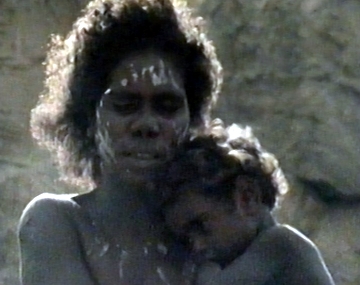
Directed by documentary filmmaker James Ricketson, ‘Alinta, the Flame’ tells how the lives of the Nyari people of Victoria (once the owners of south-eastern Australia) are shattered when two escaped white convicts are washed up on the beaches of their tribal lands in the 1820s.
One of them is speared after he molests an Aboriginal girl, the other is accepted into the community.
Inevitably, the white man arrives seeking to exchange trinkets for grazing land, and the tribalised convict eventually sells out the blacks.
 The white man’s muskets win the day, and the tribe is wiped out. Only Alinta and her child remain to carry the torch of her culture into the future.
The Nyari people are portrayed by members of the Dhamarrandju tribe of Lake Evela in the Northern Territory, who were flown to Victoria for filming. They speak their own dialect throughout, which is subtitled.
The leading characters are Naykakan Munung as Young Alinta, Yangathu Wanambi as Old Alinta, Gordon Lanyipi as Murra, William Zappa as McNab, and Adam Joseph as Finlay.
An evocative musical score is provided by ex-Skyhooks guitarist Red Symons.
 Maydina, the Shadow
Directed by David Stevens of Town Like Alice fame, ‘Maydina, the Shadow’ is set in the 1890s in a community of white sealers in South Eastern Australia.
The seal hunters kidnap Aboriginal women as sex partners and use them about as sensitively as the seals.
Maydina (Mawuyul Yanthalawuy) and her halfcaste daughter Biri (Sonia Pozzana) escape from the seal hunters who have enslaved them and intend to return to their traditional lands. But they quickly learn that these lands have been settled and that their people have now scattered.
 They eventually fall into the hands of Mrs McPhee (Julia Blake), the guardian of a church mission station.
Maydina and her child are separated when Maydina is put into service. She sickens of the alien existence and, along with Biri and another Aboriginal man, they escape, intending to re-establish a tribal way of life.
The man is shot, and Maydina and her child are separated forever.
This episode touches poignantly on the problems of Victorian do-gooders and the inappropriateness of stiff-necked Christianity to the Aboriginal culture.
 Nerida Anderson, 1939
Based on the famous incident of the walkout by Aborigines from the Cummeragunya Reserve in 1939, ‘Nerida Anderson, 1939’ is directed by Stephen Wallace.
The protagonist, Nerida (a stunning performance from Justine Saunders), is a young, rebellious Aboriginal woman who has spent several years in the city as a bookkeeper and returns to the government-run Koomalah Reserve to see her family and dying father.
She is shocked to find that an insensitive bureaucracy has made conditions worse – there is no medical access or school, the water supply is fouled, the residents must have permits to enter or leave the reserve and are punished by the manager, Mr Felton (Graham Rouse), who withholds their tea and flour rations – and attempts to stir her people into action to improve them.
 Nerida, her brother and cousin raise a petition and manage to get it to the Aboriginal Protection Board. As a result, they are charged with treason, and while the charge is dismissed, Felton is not, so the problems will continue.
Eventually, she and her family are forced to return to their tribal lands – to the Government’s great embarrassment.
Co-author Hyllus Maris’s parents were part of the Cummeragunga walkout, and her sister died during it.
Lo-Arna, 1981
The final episode, ‘Lo-Arna, 1981’, was directed by Geoffrey Nottage and told the story of Ann Cutler (Michelle Lanyon) – the 18-year-old adopted daughter of middle-class white parents in an Australian country town in 1981.
 Unknown to Ann, she was born to her adoptive father, Doug Cutler (Max Phipps) and an Aboriginal woman named Alice Wilson (Eva Birrit), who lives locally.
Without her knowledge or consent, Ann has been thoroughly Westernised and alienated from her mother’s culture, even believing that she is French-Polynesian.
A land dispute with the indigenous community where Alice lives brings her back in contact with Doug, who is responsible for representing the issue to the local government.
Alice states her wish to be reunited with Ann (whose Aboriginal name is Lo-Arna), forcing Doug to reveal the truth to Ann.
 Ann’s trusting relationship with her parents changes dramatically when the situation is explained to her.
She feels conflicted and insecure and attempts to resolve her emotional turmoil by reaching out to Alice.
Ann drives to Alice’s home, but when she arrives, she finds the situation too confronting and turns to leave.
Alice chases after Ann’s car as she drives away. The film ends when Ann stops the vehicle to finally meet her birth mother.
Women of the Sun was the first local drama aired by Special Broadcasting Service (SBS) Television. However, because that service at that time was limited to Melbourne and Sydney, the Australian Broadcasting Corporation (ABC) picked up the series, achieving greater national distribution.
The series won the 1982 ‘United Nations Association of Australia Movie Peace Prize’. It later won Logie awards in 1983 for ‘Best Original Writing for Television’.

Trending Products
![NOW Country Classics: 90âs Dance Party[Lemon & Spring Green 2 LP]](https://m.media-amazon.com/images/I/61hVquUofcL._SL500_._SS300_.jpg)