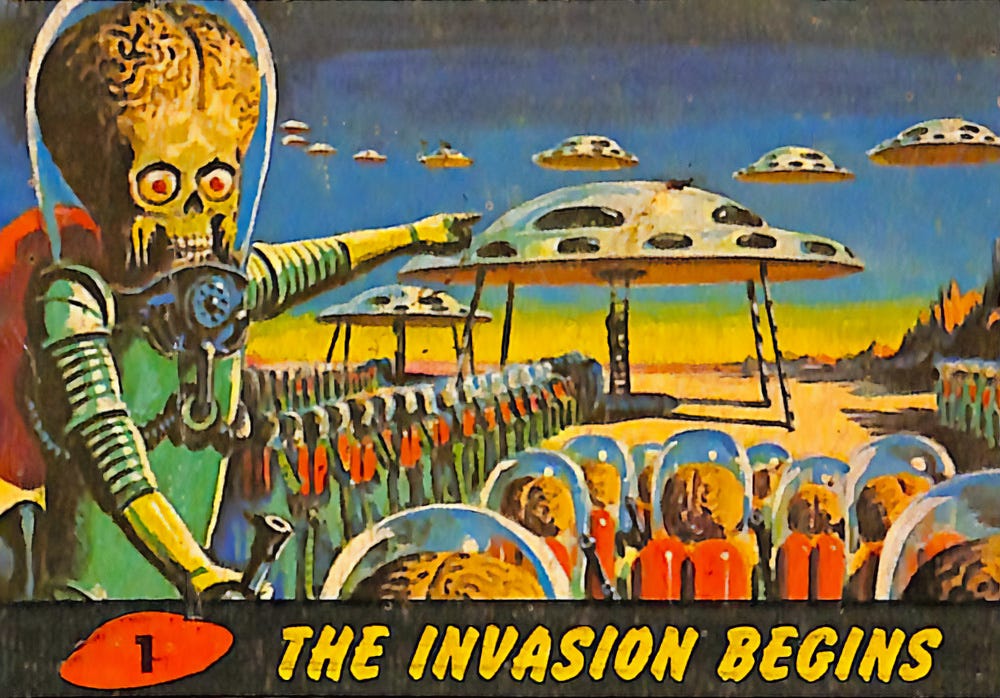
In the early 1980s, at a comic book shop near my grandmother’s apartment, I saw my first Mars Attacks cards. I had never heard of them before, but there they were under glass, so I thought they must be important. They looked old, but the imagery was colorful and intriguingly violent. So naturally, I wanted them. The problem was they were already pretty expensive. So I started putting money aside hoping to talk the owner down and land at least one of the cards. Eventually I managed to start my collection with a card in rough shape that I paid five dollars for. Over the months trying to get just that one card I learned that the series went all the way back to 1962 and that at this rate I was never going to get my hands on all 55 of the original cards.
Topps is well known in the sports card business, but they had already been doing non-sports cards for over a decade by the time they released Mars Attacks. In fact, the company got its start with a set called Hocus Focus Magic Photos in 1948. They followed that up with Hopalong Cassidy cards in 1950, before getting into baseball cards in 1951. By the early 1960s, Topps has a product team just trying to figure out what kids might spend their hard-earned nickels on. The team was led by Woody Gelman who had worked as an animator for Max Fleischer and Paramount before joining Topps. While there he would help create both Bazooka Joe and Wacky Packages.
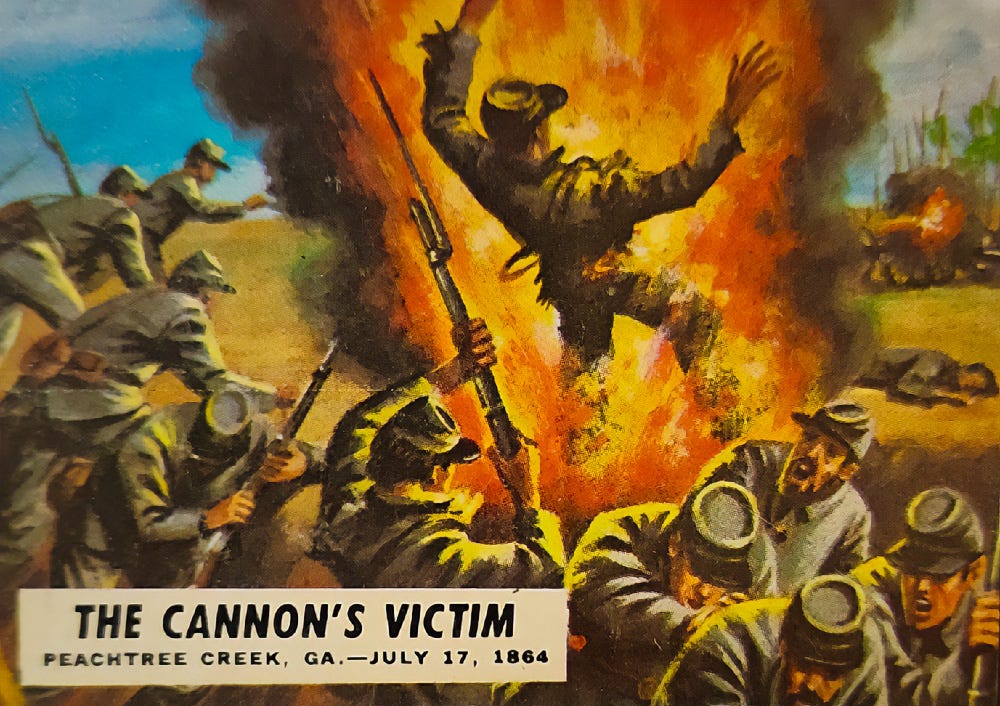
Working under Gelman was Len Brown. He joined the company as a teenager and would stay there for decades. Brown and Gelman hit upon a novel idea in 1961 when they were working on a set of cards to mark the 100 year anniversary of the start of the U.S. Civil War. They would lean into violence, exaggerating battles like Gettysburg into something that was closer to horror, at least by the standards of the time. These cards, which were called Civil War News, sold out quickly. It was a smart move and its success surprised the company. Next year they would get the opportunity to try something similar without having to borrow from history.
Brown was a big fan of science fiction and one film really seemed to stick with him, This Island Earth. The Metaluna Mutant from the movie was particularly memorable and would become the basis for what the invaders in the Mars Attack series would look like. He found an image of it in Famous Monsters of Filmland and showed it to Gelman who liked it. Artists Wally Wood and Bob Powell would combine the Mutant with inspiration from Wally Wood’s cover for EC Comics’ Weird Science #16 and turn them into finished sketches. These would be turned over to painter Norman Saunders who handled the final artwork.
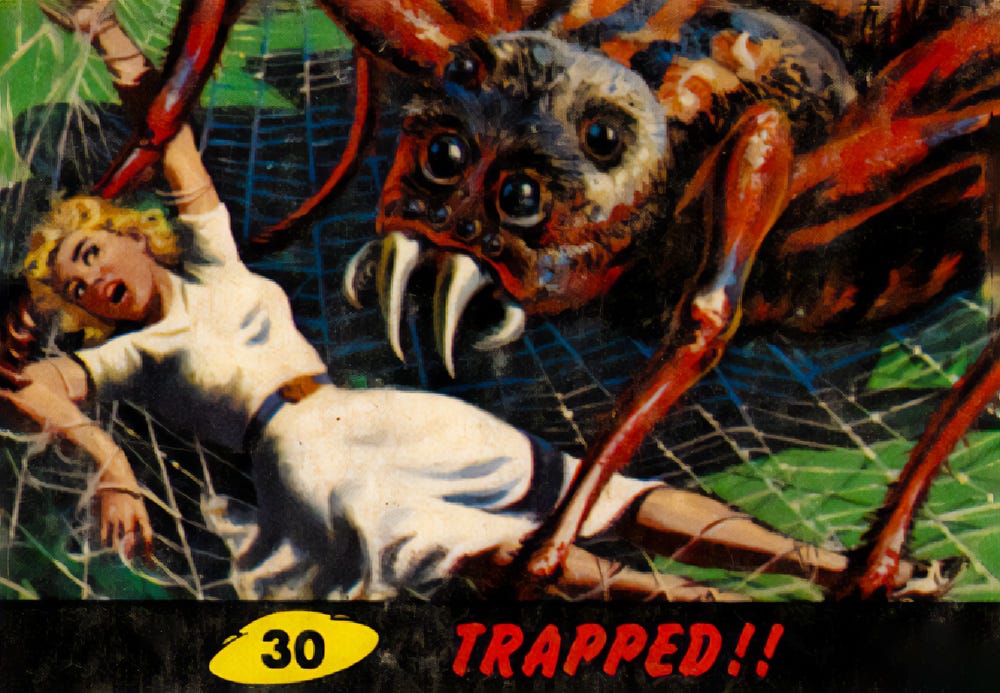
Brown would write the story of a Martian invasion of Earth that would appear on the back and unfold over 55 cards. The basic idea is that Mars is doomed and they decide that they will take over the Earth. Its pretty straightforward, but its how the story unfolds that really captured your attention. Each card tells a nice self-contained little story and leans heavily into shock value. You would expect to see humans are menaced by aliens, but when a dog is blasted by a ray gun or a person is about to be eaten by a giant spider, they were really pushing the limits of the time, and kids couldn’t get enough.
Topps was worried enough about the subject matter that they released them through a company called Bubbles, Inc. under the title Attack from Space. They only became Mars Attacks once sales were strong enough to expand. Parents were shocked by what they were seeing and started complaining to government officials. Topps thought they could placate them by repainting the more objectionable scenes. Unfortunately, they never got far with that plan. A Connecticut district attorney started asking questions about the cards and they decided it would be easier to cancel the series rather than deal with the trouble.
While the initial sales were good, the bad press made Topps look at the cards as a failed experiment. In fact, in a 1974 article in the Chicago Tribune about Topps’ success in baseball cards, they talk about their other successes and only one misstep. It says, “Among their failures or Topps flops, is a science fiction card series entitled “Mars Attacks.” So a decade later and the card line was being looked at as something the company would rather see forgotten.
This would slowly start to change as new generations started to discover them and card collecting really took off as a hobby. By 1979 article in the New York Daily News discussing the growing trend and cite two non-sports card sets by name Gum Inc.’s 1938 Horrors of War and Mars Attacks. As we moved into the 80s, the trend continue and priced for complete sets started to climb. By the 90s a good set could fetch up to $3,000. That turned out to be a bargain. Just this decade, sets and cards are going for tens of thousands of dollars.
Like all cards, rarity drives up the price and some of these cards were really rare. Not because of the number printed, but the bad habit many young card collectors have of using rubber bands. I did this myself as a kid. I would put a set together and then take a rubber band and wrap it up. A lot of those cards stayed with the rubber band on it when it went into storage. So years later, you will pull out a bundle of cards and the top and bottom cards will be ruined from contact with the rubber band.
Because of this, Card #1, The Invasion Begins, is famously the hardest card in the set to find in good shape, since it sat on the outside of the pack and took the most damage. The checklist, card #55, has the same problem from the other end. In January of 2025, a copy of The Invasion Begins sold at auction for $54,067.20, a record for the set and a huge jump from the $19,981.35 a lesser graded copy brought just two years before.
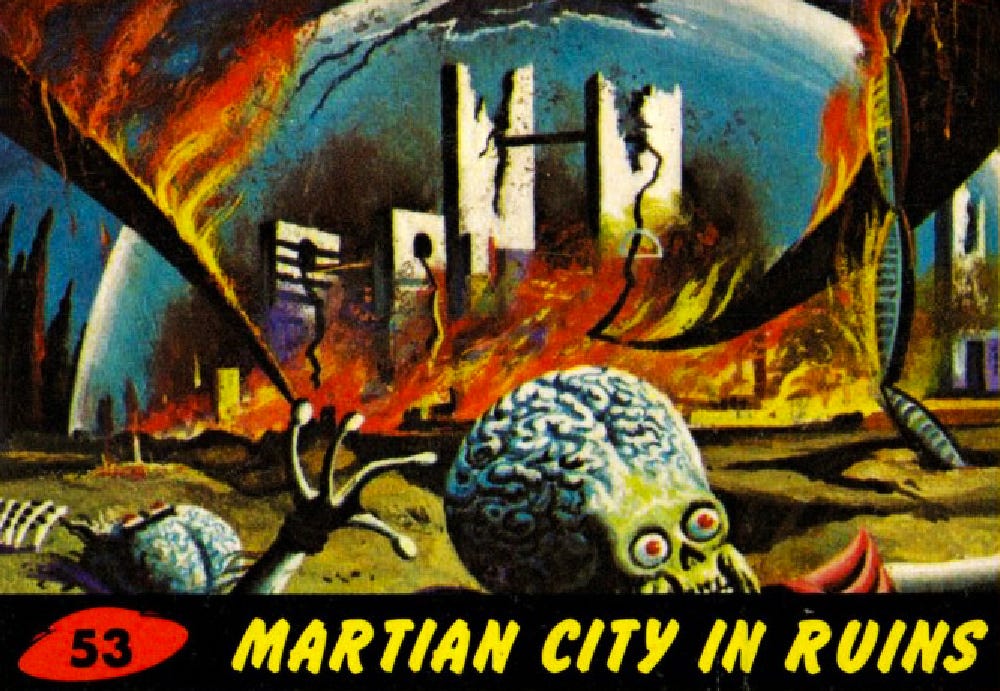
The cards’ value would have probably slowly increased over time, but they got a boost in 1987. That is when Mario and Eileen Bruno approached Topps with the idea of reviving Mars Attacks as a mini comic series. They got a meeting with Sy Berger, the Topps executive known as the father of the modern baseball card. He liked the idea and green-lit the project. Berger was introduced to Len Brown who was still at the company and a young talent at the company named Gary Gerani. The partnership resulted in a four issue series published by Pocket Comics in 1988.
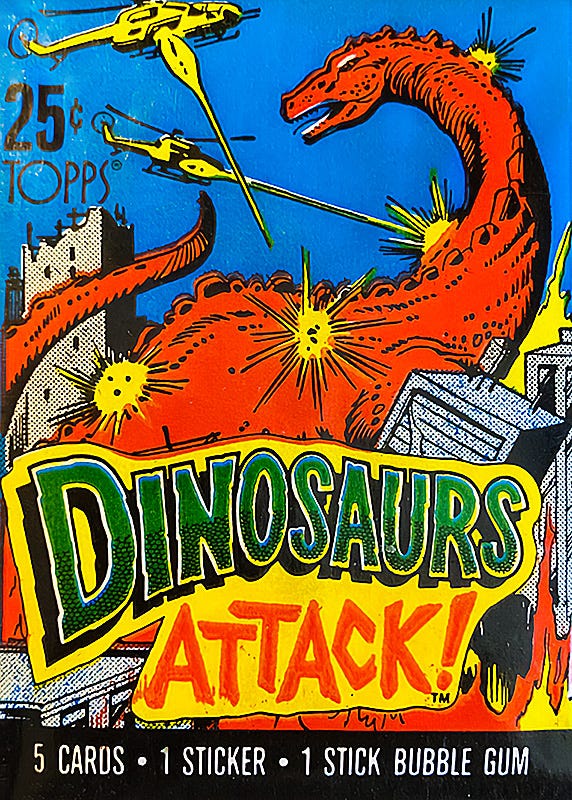
Fun fact about Gerani he was influenced by Mars Attacks when he created another Topps card series about prehistoric monsters loose in modern cities called, Dinosaurs Attack! This set was also released in 1988. Several decades later during some successful Kickstarter campaigns by Topps we would actually get some crossover sets between the the Dinosaurs and the Martians.
Fans of the set got a treat in 1994 when Topps finally gave the original set a proper reissue. They paired all 55 classic cards with 45 brand new ones drawn by a whole roster of comic artists. Its amazing what three decades can make and the new cards could be edgier than the original. Unsurprisingly the reissue sold out fast. Older fans could enjoy a brand new set and all new fans could discover the magic of Mars Attack for the first time. What more could fans of the cards hope for?
As it turns out some people in Hollywood were fans of the cards. Screenwriter Jonathan Gems pitched the idea of a movie to Tim Burton in 1993, after an earlier attempt by director Alex Cox back in the 1980s never made it past a few script drafts. Burton wanted to make the film in the style of a 1970s disaster film with a large ensemble cast and that’s just what he made. With an impressive cast and a look that aped 1950s science fiction B movies, Mars Attacks! hit screens on December 1996 and I was there on opening night at my local theater.
I loved it, but unfortunately, I was in the minority at the time. The film opened to mixed reviews and a disappointing box office. Fortunately though, it did much better globally and over time has developed a cult following.
While the movie might not have been a big hit. The cards it was based on got a boost from its release. As a tie-in with the film they released a new set of wide cards that are still a great starting set to get into collecting Mars Attacks cards. They didn’t stop there. New card sets and comics hit shelves and we even managed to get some toys. Not just the ones related to the movies, but some great stuff from companies like Funko and Super7.
I wasn’t around when the original Mars Attacks cards were first released. If I was, I would like to think I would have been one of those kids who tried to collect them all. Fortunately, they found plenty of fans among those first collectors, and that interest helped keep Mars Attacks alive long after Topps had written the set off. It eventually led to reissues, new card sets, comics, toys, and even a movie. Most of us will never own a complete original set, but there are still plenty of ways to collect Mars Attacks.
Trending Products