Growing up in New Jersey, I was lucky to be surrounded by some of the best pizza in the United States. So when chain pizza places started to creep into our area, they were at first pretty easy to ignore. This was especially easy since my mom was very opposed to spending money at anywhere that wasn’t a beloved place she had been going to, often for decades. It was an independent pizza paradise, but it couldn’t last. Advertising for these chains was relentless and eventually in the nineties, when novelty pizza released started to become more common, I couldn’t resist. While I felt guilty, it was a fun time to start trying these chains. Their cheap and often novel pizzas might not have been as “good” as some of the local places, but they could be interesting and fun.
In 1995, Pizza Hut was riding high on their Stuffed Crust Pizza success and was looking for the next great thing. It wouldn’t take them too long to figure out a follow-up to stuff crust. What if, instead of stuffing something in the crust, you instead stuffed cheese inside the entire pizza? The result of this thinking was the TripleDecker Pizza and its spin-off the TripleDeckeroni. These decadent creations would entice Americans to indulge in cheesy layered tastiness. It wasn’t a long-lived creation, and often overshadowed by other pizza novelties, but it is well-remembered for those who indulged. So let’s take a look at the rise and fall of Pizza Hut’s TripleDecker Pizza.
At the start of 1995, Pizza Hut was in a great position. It had 8,300 locations in North America and was the leader of the then $30 billion dollar pizza industry. It wasn’t alone nationally, but other chains like Domino’s and Little Caesars were needing to play catch-up with their product releases. Pizza Hut has released stuffed crust in March of 1994 and in early 1995 they were predicting sales around $1 billion by its anniversary. This was a huge number, equally about 30% of the company’s sales which would be up 7% from the $3.2 billion they made in 1994. On top of the world, and realizing that maybe Americans weren’t as health conscious as some news outlets were claiming, they released a product with even more cheese than their stuffed crust.
Going vertical allowed them to add twice as much pizza as in a regular pizza. To build a pizza they start with a crust topped with a six cheese blend. On top of this is placed a second this crust that has perforations and large hold in the middle to let steam escape while the pizza bakes. They then use a small tool that trims and seals those crusts together. After that you prepare the pizza like you would a normal pizza, adding sauce, more cheese and even topping before putting it in the oven. It was priced the same as the stuffed crust pie, about $9.99 with one free topping. You could even mix it up with other established Pizza Hut products, for example make a Supreme TripleDecker, which would run you $12.99.
They had been working on the idea for nearly a year. Like any food product, testing and training is important. How you make a food product can change based on weather, and even altitude. They worked out all their details in their test kitchen, but then prepared training materials that went to every store in the chain. Launching it at start of the year gave them an opportunity they didn’t want to pass up, a Super Bowl XXX reveal with a new spokesman, legendary actor Anthony Quinn. While not exactly a youthful choice, Quinn’s commercial is pretty funny.
The product made a splash, but Pizza Hutt didn’t sit on their laurels. They decided to play with the format by quickly unleashing the TripleDeckeroni Pizza in May of that year.
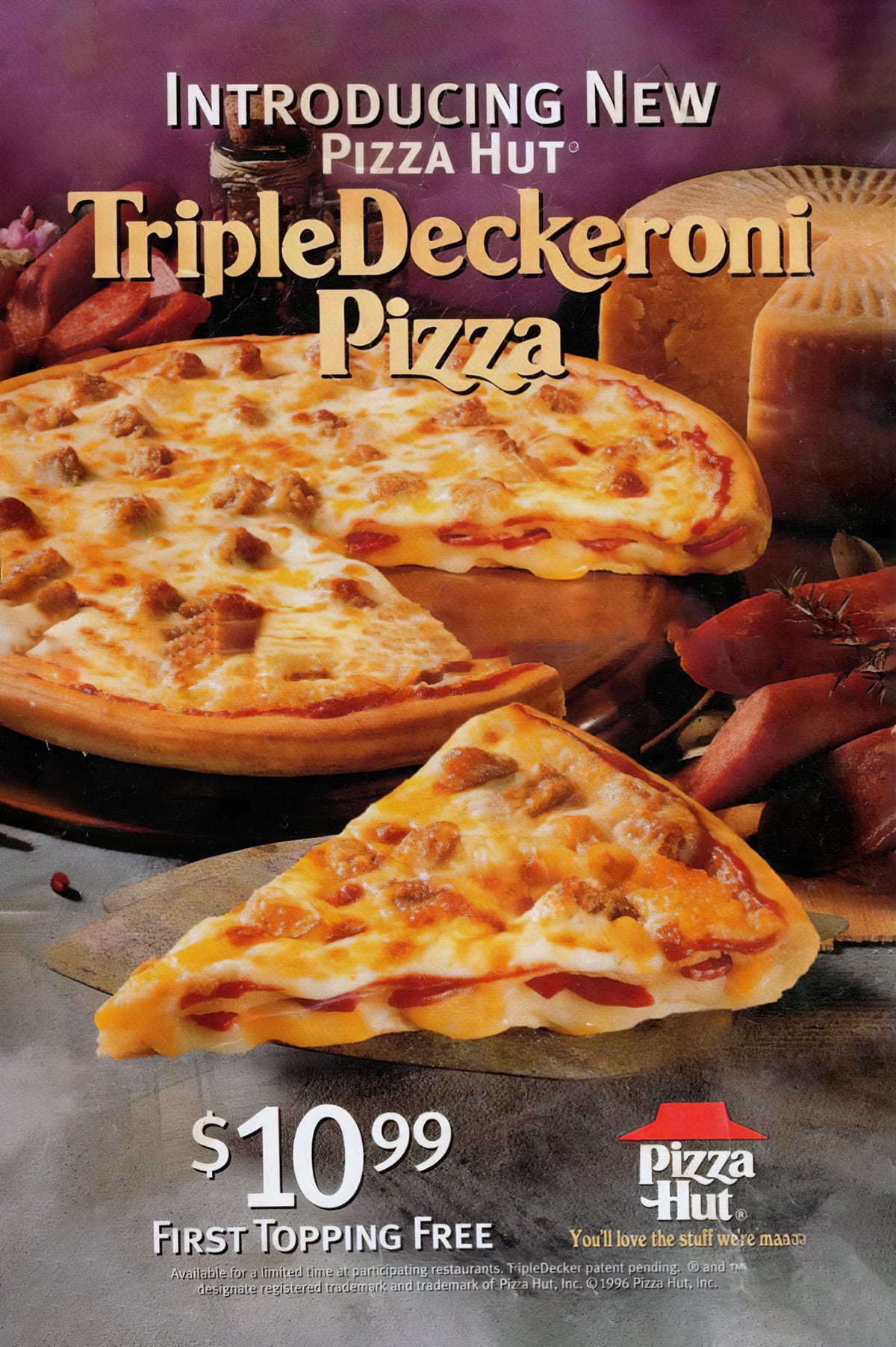
This was very similar to the standard TripleDecker, except in one key way, it was chock full of pepperoni. You know that first pizza where they added the six cheese blend? Now add a hearty layer of 90 pepperoni pieces that pretty much guaranteed that every bite was meaty. Remember, you could still get a free topping on top as well. So you could go crazy with pepperoni, and many people did.
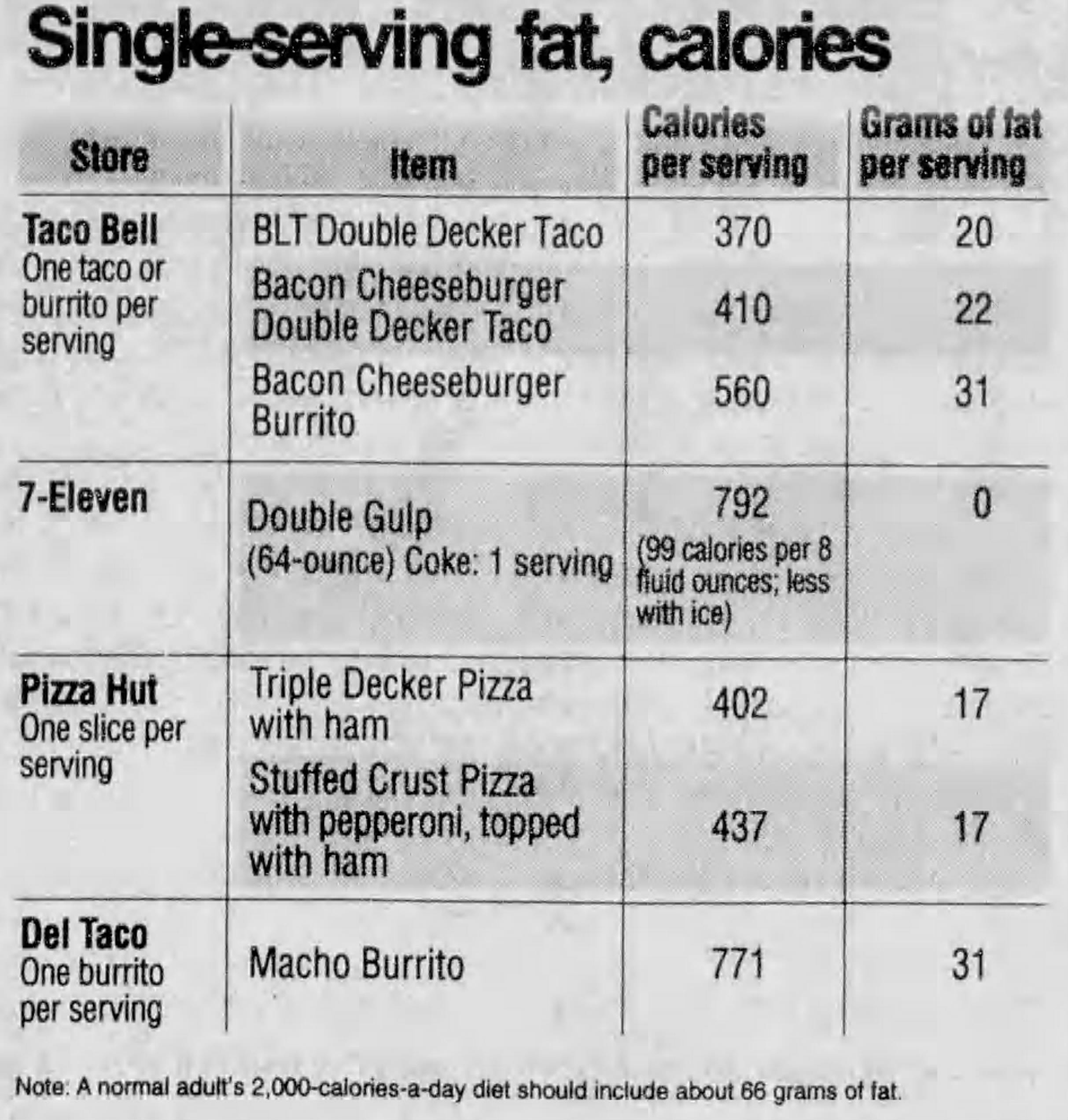
Remember I mentioned that Pizza Hut wasn’t too concerned about people’s reaction to the nutritional value? Allan S. Huston, who was president and chief executive of Pizza Hut at the time said in an article by the Associated Press, “Quite frankly, low-fat is on those things that customers talk about, but not something they do.” This didn’t stop an outcry from reporters, advocates, and health groups who pointed out that one slice of the original TripleDecker with a meat topping contained 400 calories and 17 grams of fat. Here is a chart February of 1995 from USA TODAY.
While some were taking these health questions seriously, a lot of the discourse felt kind of jokey. With people comparing it to a heart attack in a box. Still, that noise didn’t seem to have much to do with why it disappeared. By March 1997 the item was being phased out quietly, with no press release or official explanation. Trade publications of the time never cited health concerns, only that it was one of several short-run “innovation” pizzas that came and went in the mid-nineties. The likelier reasons were more mundane, the sort that rarely make headlines, like high prep costs, inconsistent baking, and a short-lived novelty appeal. Fans remember it fondly, but Pizza Hut moved on to simpler, cheaper limited runs soon after.
Financially, Pizza Hut’s momentum was already cooling by the time the TripleDecker was fading from menus. After a record 1995, with sales jumping more than 15 percent thanks to the success of Stuffed Crust Pizza, the company entered 1996 on shakier ground. Systemwide sales slipped to around 4.9 billion dollars, and same-store sales dropped roughly 4 percent. The slowdown suggested that the novelty boom had hit its limit, and that frequent limited-time products were starting to feel like gimmicks instead of growth drivers. In that light, the quiet disappearance of the TripleDecker wasn’t a retreat from indulgence so much as a sign that Pizza Hut was tightening up, trying to regain consistency after a few years of chasing spectacle.
The TripleDecker was a good example of what happens when a big chain decides to chase novelty for its own sake. It wasn’t meant to change the way people ate pizza, just to keep their attention a little longer. For a while, it worked. It was a kind of edible spectacle, the sort of thing you’d order for a group just to see what it was like. Looking back, it fits right into the mid-nineties mix of indulgence and irony, when food trends were loud and a little absurd. The TripleDecker burned bright for a moment, left its mark on the menu boards, then vanished as quietly as it arrived, leaving behind one more memory from a time when even pizza felt like an event.
Trending Products
![NOW Country Classics: 90âs Dance Party[Lemon & Spring Green 2 LP]](https://m.media-amazon.com/images/I/61hVquUofcL._SL500_._SS300_.jpg)