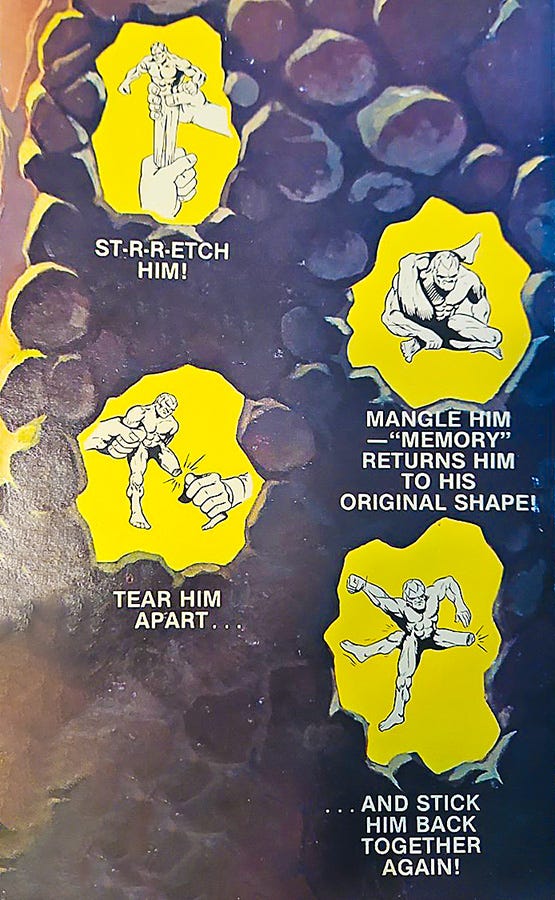
For Christmas of 1983, I received a toy that wasn’t on my list, a Manglor. Specifically, the one I received was Manglord. While I didn’t ask for him, I was pretty excited to get him. The TV commercials promised a toy experience like no other. I could stretch, crush, and even tear Manglord apart and he could be returned to his original shape or whatever shape I chose. I remember playing with it that morning and putting it aside. When I went back to it again, it was gone. Manglord could survive a lot of abuse, but he wasn’t coming back from being eaten by a dog. I wish I could say this was the last time I saw him, but sadly it was not, and it is something I would rather not talk about.
Manglors were made by the company Ideal and were being demonstrated at the New York Toy Fair in February 1983. They would hit store shelves later that year. In a crowded field of action figures, the company thought they were onto something different. A figure that invited being damaged.
Manglors were made from Sorbothane, a soft viscoelastic polyurethane material that behaves partly like rubber and partly like a very thick gel. In this toyline it was a soft and sticky material that could be stretched, manipulated, and crushed. So kids could even pull them apart and stick them back together however they wanted. Heck, you could even combine parts from other Manglors. The problem was that they worked better when being destroyed than when being repaired.
You could easily tear them apart and the pieces were sticky enough to be pressed back onto the figure. That didn’t mean that they returned to their original condition. After being torn apart, pieces were difficult to place back together in the right way. Also, when you kept tearing them apart, it weakened the figure. So the thing you were encouraged to do was rapidly wrecking your toy. This attracted attention before 1983 ended.
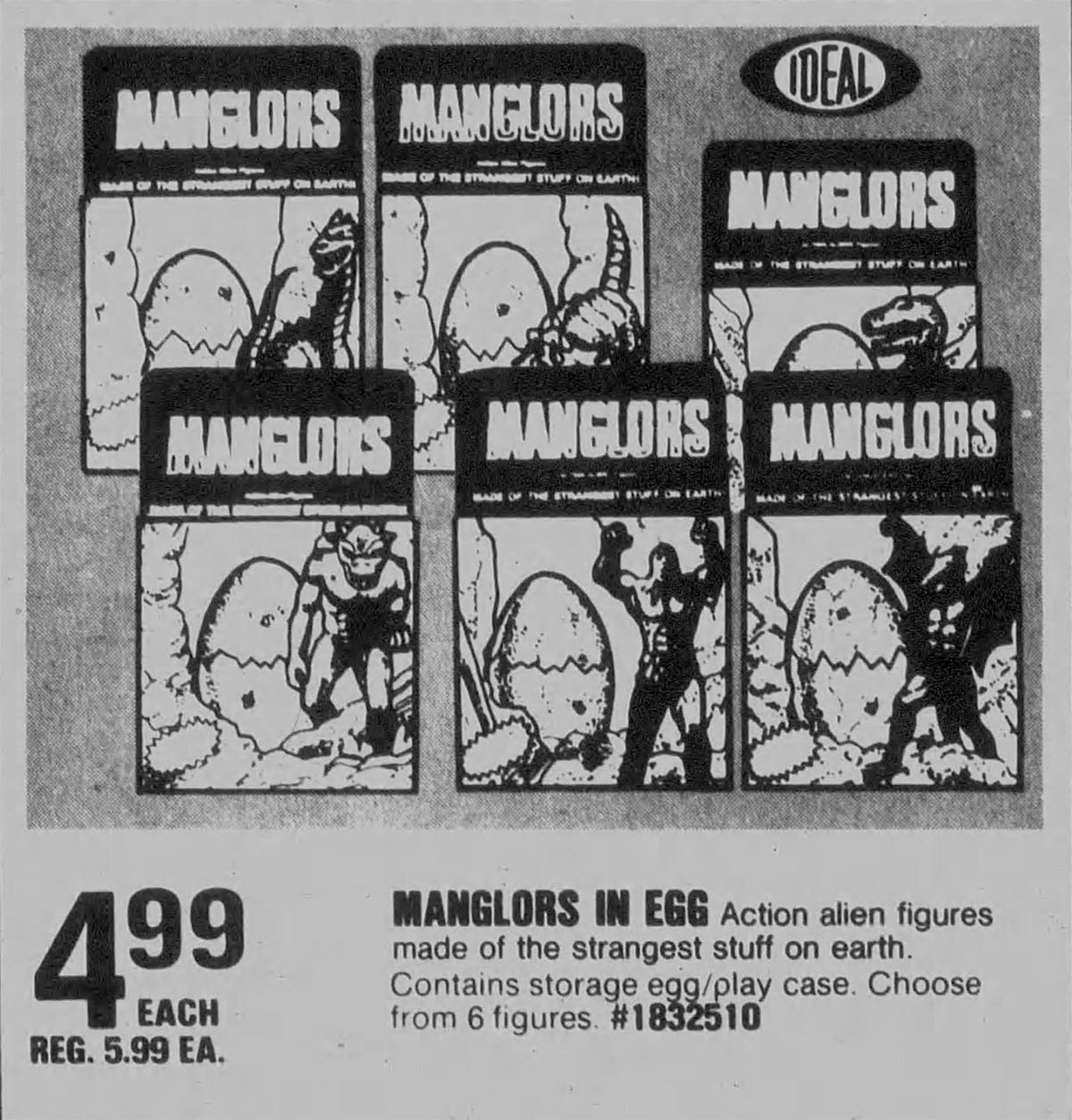
Before I get into that, let me tell you a little about the figures and playset. The original figures were Manglord, Manglosaurus, and Manglodactyl. They also created a playset called Manglor Mountain. The next year they added Manglodemon, Manglodragon, and Manglizard for a total of six figures. With the new figures they added a new package for them. The Manglors now came inside plastic eggs called Prehi Storage Play Eggs. These eggs contained a base and figure stand and worked as packaging, storage, and a small play environment.
Manglors retailed for $5.99, but during the first year you could find them on sale for as low as $3.99. The playset would run you anywhere between $9.99 and $15.99. This price would start to slip during year two and drop even further as the toys went into the clearance bins. Five years later, you could still find the toys being advertised with figures going for less than a dollar.
As I mentioned, not everyone was convinced that these were good toys. The Consumer Affairs Committee of Americans for Democratic Action, long name, included Manglors on its list of the year’s worst toys. The group had children test toys and judged them partly on whether they worked as advertised, and Manglors failed their test. When kids tore a figure into pieces, not only did it not go together as they hoped, the kids also had trouble determining where the pieces originally belonged. The group also had some complaints about the goo used in the playset, but when Ideal was asked to comment, they responded by saying they had not received complaints of that type.
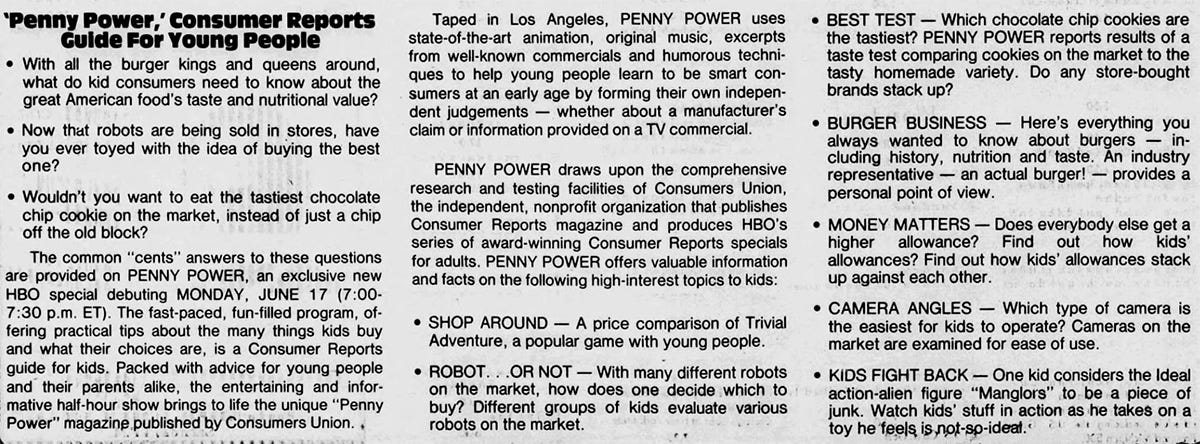
The criticism didn’t stop there. About a year later, the Consumers Union, which publishes Consumer Reports, noted the same basic problem. They would cover the Manglors in their magazine and TV show aimed at kids, Penny Power. In a June 1985 episode they were highly critical of the Manglors, referring to them as “a piece of junk.” Sadly, I couldn’t find the episode, but only the newspaper coverage of it.
Manglors must have been at least initially popular. After all, Ideal released some new ones during year two and they were still showing up in toy catalogs. Still, I can’t find any sales figures and it’s hard to tell if this was just momentum based on predictions or real market driven decision making. The timing also didn’t help them. The mid eighties action figure market was very crowded. They might have had an unusual feature to make them stand out, but that was being questioned in the press.
Two other roadblocks were media support and variety. The most successful toys from this era often had some manner of cartoon or comic attached to them. These are often great places to introduce new additions to a toyline. But with just seven toys, there wasn’t a lot to build upon or market. Whatever the case, by the end of year two, it is pretty apparent that the Manglors were a dead toyline.
They might be better remembered if they had been easy to collect. Unfortunately, the way the toys were made and how they were played with made them very delicate as they aged. Surviving figures in good original condition became difficult to find. So the very feature that helped sell Manglors also worked against their long term collectibility. Fortunately, they were not forgotten.
Collectors eventually helped bring the name back. Toyfinity secured the rights to the Manglors property in the early 2010s and began working with Onell Design on plans to revive it. In 2015, Onell released Glyos figures inspired by the original Manglors while the two companies continued developing a new version of the toyline. The actual Manglors revival arrived in 2023 using the Glyos building system. Its removable hard plastic parts could actually be taken apart and reconnected, finally allowing the basic Manglors idea to work the way the original toys had promised.
The Manglor idea was simple. What if you could break your toy and put it back together any way you want? The promise was great, but the technology at the time really couldn’t deliver. That didn’t mean it wasn’t memorable. Kids like myself thought it was really cool and years later, when another company revived the idea with a more durable variation, we opened our wallets. They might not be as popular as GI Joe or the Transformers, but they have had an interesting run.
Trending Products