20 April 1992
“We’re here to celebrate the life and work and dreams of one Freddie Mercury,” said a clearly emotional Brian May, addressing the crowd of 72,000 that flocked to London’s Wembley Stadium on 20 April 1992 to witness the largest gathering of upper-echelon talent since Live Aid (1985).
Flanked by his band mates, drummer Roger Taylor and bassist John Deacon, the Queen guitarist vowed: “We’re gonna give him the biggest send-off in history!”
If the event seemed to meet that goal, it was successful on another score as well: The first rallying cry of any substance to be heard from the tight-lipped rock community since the AIDS crisis surfaced, “A Concert for Life” was a hopeful sign that rock and particularly hard rock might be ready to lift its self-imposed AIDS gag order.
Although the four-hour concert appeared to come off nearly without a hitch, surviving until the day of the show with sanity intact was a challenge for the members of Queen.
“The night that Freddie died, we said, “Well, we should give him an exit in the true style to which he’s accustomed,” said May before the show. “From that to this, it’s been a long road. We actually almost gave up the idea at one point.”
The nightmarish logistics weren’t the only hurdle. After the lineup was announced, the AIDS activist group ACT UP London began screeching about the participation of Guns n’ Roses, first demanding they be dropped from the bill, then urging other artists to shun them and the Wembley crowd to boo them off the stage – a concept the members of Queen found ludicrous.
“ACT UP will have no influence on the audience whatsoever,” said an angry Taylor. “And I have a two-word message for them, which I’m prepared to give them at any moment they want it.”
“People seem so blind,” said May earnestly. “Don’t they realise that the mere fact that Guns n’ Roses are here is the biggest statement that you could get? We think it’s time that everybody realises that whether you’re gay or straight, you’re entitled to your feelings. You cannot come down on anybody because of the way they feel. That’s got to be an outdated concept, and I hope that the concert will help to bring that about.”

Although the audience at Wembley was primarily there to pay tribute to Mercury, the event’s AIDS agenda was never far from anyone’s mind.
Red ribbons and AIDS-awareness sashes transformed the floor of the packed stadium into a scarlet sea. Elizabeth Taylor pointed a regal finger at the crowd and gave a lengthy, impassioned lecture on safe sex. David Bowie, in one of the evening’s most touching moments, knelt during his set and recited The Lord’s Prayer.
George Michael, quoting figures from the American Foundation for AIDS Research (AmFAR) forecasting 40 million people worldwide infected with HIV by the year 2000, scolded the crowd: “If any of you really think that those are all going to be gay people or drug addicts, you’re lining up to be one of those numbers.”
Aside from the aforementioned, the members of Queen kept the AIDS-speak to a minimum. “That’s definitely what Freddie would have wanted,” said Taylor. “For fuck’s sake, dears, have fun!”” And indeed, there was plenty of that to be had.
 Metallica kicked off the afternoon portion of the show, which was devoted to the metal bands on the bill performing their own material, although Extreme delivered a spellbinding Queen medley, and Def Leppard, joined by May, capped its set with Now I’m Here.
Other artists made one-song appearances: Bob Geldof performed Too Late God; Spinal Tap mugged through Majesty of Rock.
Guns n’ Roses’ set, the show’s potential hot spot, passed without incident.
At one point, Axl Rose, looking like he was itching to get something off his chest, sat down on the drum riser long enough to send an anticipatory buzz through the crowd, but after a moment’s pause, he resumed the set with Knockin’ on Heaven’s Door.
Rose later confirmed that he had been sneaking up on a diatribe against the US government, the Food and Drug Administration and the American Medical Association, for hindering access to alternative forms of medicine that could be valuable in the fight against AIDS.
“I thought about it,” said Rose, “but I couldn’t do that to Queen. Everybody was so happy, I didn’t want to spoil the vibe.”
At dusk, the surviving members of Queen launched their own segment. Playing live for the first time since 1986, without Mercury up front to galvanise them, had to be a bittersweet undertaking, and there were a few moments when May in particular seemed close to losing his composure.
 The audience’s warm reception for Too Much Love Will Kill You, a composition May debuted at the concert on piano, left the guitarist looking lump-throated.
Later in the evening, as Robert Plant shimmied his way through Crazy Little Thing Called Love and the song’s lyric “Ready Freddie” became a chant, May sang his “Ready Freddies” while looking heavenward, and his voice broke on the last one.
But for the most part, the members of Queen were all smiles, apparently enjoying the catharsis. Musically, they were in fighting trim, and they had plenty of top-notch help.
Some highlights included Slash and Def Leppard vocalist Joe Elliott showing off on Tie Your Mother Down; Metallica’s James Hetfield barking his way through a brilliant Stone Cold Crazy; Seal’s subdued Who Wants to Live Forever; and Paul Young on Radio Ga-Ga, during which the Wembley fans created the awe-inspiring spectacle of 72,000 pairs of hands clapping in perfect unison, their arms jabbed aloft with eerie military precision, after the Hitleresque crowd salute born in Queen’s Ga-Ga video.
 David Bowie and Annie Lennox (who showed up in a hoop-skirted ball gown, her eyes blacked out raccoon-style), joined by guitarist Mick Ronson, outdid themselves on Under Pressure; George Michael vocally outstripped everyone else on the bill with his soulful showing on Somebody to Love.
Echoed by the London Community Gospel Choir, Michael glided effortlessly through the song’s roller-coaster melody – right down to that daunting, glass-shattering note toward the end.
Elton John‘s arrival onstage for Bohemian Rhapsody set in motion a blur of warm ‘n’ fuzzy emotion. Elton began the song an octave lower than Mercury had sung it, and the Wembley audience backed him in Mercury’s higher register, like a massive children’s choir.
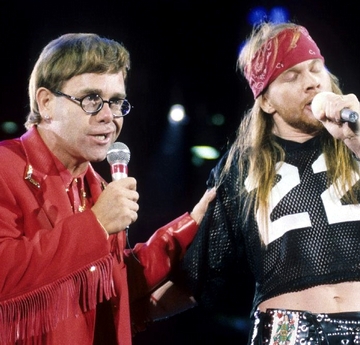
As the song’s operatic interlude ended, Axl Rose materialised to sing the hard-rock break. He and Elton finished the song in a duet.
As they drew to the “Nothing really matters” close, the two tentatively embraced – and supplied the event with its warmest moment of fuck-the-labels unity. After Elton’s over-the-top rendering of The Show Must Go On, Rose reappeared for a turn on We Will Rock You, eliciting from the crowd another Hitleresque display and priming them for the companion song.
 “There’s one person Freddie would’ve been proud to have stand in his footsteps,” said May, introducing Liza Minnelli, who, despite her status as one of Mercury’s biggest influences, was said to be sweating bullets backstage at the thought of facing his fans.
As it turned out, Minnelli’s Rat Pack stylings on We Are the Champions proved the camp pièce de résistance of the event.
Mercury – all tricked out in crown and robe, gazing down imperiously from the video screens to the strains of God Save the Queen – closed the show. He also, as was his custom, stole it.
The singer may have had to watch his grand send-off from some distant vantage point, but his absence was purely physical. Throughout the day and into the night, whenever the video screens came to life with images of Mercury in his many wacky incarnations, the Wembley crowd did his bidding – answering his call and response, falling to a hush when he spoke – as if he were there in the flesh.
And despite the parade of mega-stars assembled to bid him farewell, it was the fans who ultimately paid him the finest tribute. They listened to one platinum songbird after another attempting to master Mercury’s music and came away from each new performance with the same forlorn conclusion: It was good . . . but it just wasn’t Freddie.
This article by Kim Neely originally appeared in Rolling Stone issue 633.
Video
Trending Products
![NOW Country Classics: 90âs Dance Party[Lemon & Spring Green 2 LP]](https://m.media-amazon.com/images/I/61hVquUofcL._SL500_._SS300_.jpg)